Tennis supporters erupted across social media after 2023 Wimbledon champion Markéta Vondroušová publicly criticized an unexpected anti-doping visit that she says violated the sport’s strict testing protocols.
The Czech star took to social media late at night to detail how a doping control officer arrived outside her required daily testing window, igniting a heated online debate about privacy, fairness, and the broader pressures elite athletes face behind the scenes.
Understanding Tennis’ Anti-Doping Whereabouts Rules
Under the Anti-Doping Program, every player must file quarterly whereabouts with a mandatory 60-minute window each day when they guarantee they will be at home and available for a surprise test. These whereabouts rules fall under the “Three Strikes Rule,” which penalizes athletes who either fail to file accurate location information or miss their declared hourly window.
Three failures within a 12-month period are considered an anti-doping violation equivalent to a positive test, resulting in suspensions that typically range from one to two years. However, the duration can be extended to four years, depending on the athlete’s degree of fault.
The rule has already derailed the careers of multiple players, including former World No. 50 Mikael Ymer, who received an 18-month suspension in 2023 after the Court of Arbitration for Sport overturned an initial acquittal, and American Jenson Brooksby, who was also suspended for 13 months after the tribunal determined his degree of fault was “high.” Both returned in early 2025 to rebuild their rankings on the Challenger circuits.
The ITIA also emphasizes that out-of-competition testing can occur at any time, whether an athlete is in the Registered Testing Pool or not. Although authorities aim to avoid unnecessary intrusion, they are not liable for disruptions.
Even so, players in the Registered Testing Pool must still report daily whereabouts through ADAMS, and any inaccurate filing may trigger a Filing Failure, while missing the declared window can be recorded as a Missed Test. Against that backdrop, Vondroušová’s claims struck a familiar nerve, raising questions about how strictly and uniformly the rules are enforced.
In her Instagram story, she explained that she has always respected the requirement to remain home for her appointed testing hour. “Every day, we are required to be at home for one specific hour for doping control. I respect that rule every single day,” the former World No. 6 wrote.
But she said her latest experience crossed a line. She stated that a tester showed up at 8:15 p.m. and claimed her designated time “didn’t matter,” insisting she undergo the test on the spot.
MORE: Frances Tiafoe’s Girlfriend Can’t Hide Her Annoyance at the American Being Subjected to Random Doping Test
When she objected, noting that the visit fell outside her allotted testing hour and encroached on her personal time, she claimed the official responded by saying, “That’s just part of being a professional athlete.” In a follow-up message, she clarified her intent:
“Is it normal for doping officers to sit in our living rooms at night waiting for us to pee? This is not about avoiding a test. It’s about respect. Respect for the rules that we follow, and for the personal life we’re entitled to after a long day of training and competition. Rules should apply to everyone. Even to those enforcing them.”
How Did the Tennis Fans Respond to Markéta Vondroušová’s Doping Test Complaint?
Once the news spread, fans wasted no time weighing in. Some expressed confusion, with one user writing, “I understand what she’s saying, but I thought they can be tested at anytime? Tiafoe’s girlfriend posted something similar on IG about how inconvenient it was that a tester showed up early morning to test him.”
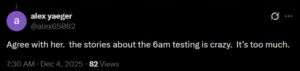
Another fan lamented the disruption, writing, “This is really intrusive! Poor Marketa.” Others agreed wholeheartedly with her criticism of the timing, with one commenter saying, “Agree with her. The stories about the 6 a.m. testing is crazy. It’s too much.”

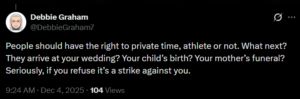
Some fans questioned the boundaries of the current system, asking whether the intrusion could escalate even further. “People should have the right to private time, athlete or not,” one commenter wrote. “What next? They arrive at your wedding? Your child’s birth? Your mother’s funeral? Seriously, if you refuse it’s a strike against you.”
Additional reactions captured the growing frustration many feel about the testing process, with one fan admitting they “would have hated being a professional athlete,” while another called the situation “beyond unreasonable” and even hoped “that person gets fired.”