Local news
One Boston neighborhood has seen a 149 percent increase in needles reported to the city by 311 over the past five years.
Brian McCarter, a South End resident, holds used needles he found in the street near his home in July 2025. Barry Chen/The Boston Globe
Scattered around trash cans. Scattered across the gravel paths. They are disposed of near playgrounds.
Used needles and syringes have been a relatively common feature in some Boston neighborhoods for years, sparking action among advocacy groups and city officials.
The total number of needle pick-up calls across Boston rose nearly 71 percent from 2022 to 2025, according to a city analysis. 311 Although this is still 17 percent lower than the number recorded in 2020, Boston.com data shows.
What is 311?
Boston 311 is the city’s non-emergency service line where residents can request various city services, from rodent control to pothole filling and graffiti removal.
While the system captures thousands of service calls each year, countless issues go uncounted. Orders only reflect incidents reported through the BOS:311 app or direct calls to the City.
City officials say many needle pickups are handled by a dedicated team that works beyond 311 individual requests.
“Our citywide mobile team operates on a rapid response model, following up on 3-1-1 calls while conducting proactive sweeps. This team works seven days a week, from 7:00 a.m. to 7:00 p.m., conducting proactive sweeps of parks, schools and hotspots throughout the city,” Boston Public Health Commissioner Dr. Bisola Ojikoto said in a statement to Boston.com. A Public Health Commission spokesperson declined a request for a phone interview and will only respond to questions submitted via email.
Needles and syringes are classified as “sharps,” a medical term that refers to objects with points or edges that can puncture the skin. Used sharps are dangerous to humans and animals if not disposed of properly, because they can spread infections such as hepatitis B and human immunodeficiency virus (HIV). According to the Food and Drug Administration.
These Boston neighborhoods saw the highest number of needle pickup requests In 2025
While Boston overall has seen a 17 percent drop in needle pickup requests since 2020, certain neighborhoods have seen sharp increases over the past five years.
The most significant increase was in Jamaican plain. With 235 claims in 2020 and 585 in 2025, the borough saw a 149 percent increase in needles reported to the city. The next biggest was in return bay, Which saw a 73 percent increase in receipt requests, from 798 in 2020 to 1,382 in 2025.
the Southend, Roxburyand Dorchester They account for the vast majority of all applications in 2020 and 2025, although all boroughs have seen a decline over the past five years.
The South End alone accounts for 36 percent of citywide applications in 2020 and 29 percent in 2025, with 2,507 applications. The neighborhood includes the intersection of Massachusetts Avenue and the intersection of Melnia Cass Street, also called “Mass and Cass,” the epicenter of Boston’s opioid and homelessness crises.
the Fenway-Kenmore The region saw the largest decline in five years in the number of needles reported, with a 54 per cent drop.
The intersection of Blagden and Exeter streets in Back Bay, behind the Boston Public Library’s Central Branch, was the specific location with the highest number of pickup requests in 2025. In 2020, the intersection recorded just two requests. In 2025, this number rises to more than 100.
With the tents removed, needles remain a persistent problem
In 2021, tents filled the sidewalks around Mas and Cass. In November 2023, Mayor Michelle Wu The tent evacuation decree was announced after concerns about public safety escalated.
“You don’t see tents everywhere anymore,” says Sue Sullivan, executive director of the Homeless Back2Work recovery assistance program. “You used to see hundreds of tents.” The jobs program works through Newmarket Business Improvement Districta non-profit organization run by Sullivan that aims to help businesses in the neighborhood surrounding Massachusetts and Cass.
She said the ordinance pushed people away from congregating around Newmarket Square, causing it to spread to other communities, such as Nubian Square in Roxbury and Andrew Square in South Boston.
The South End in particular has seen neighborhood unrest resulting from dispersal, Residents and businessmen said. Although more than two years have passed since the law was passed, residents are still pushing for crackdowns on open drug use and more sharps pick-ups, a movement that saw a resurgence after a 4-year-old child stepped on a needle in South Boston in July 2025.
@SouthEndSOS, an Instagram account that posts scenes from the area, posted in October 2025 that a volunteer group picked up 175 needles in three days.
“This is what parents, residents, and volunteers are finding: kids should be playing, dogs should be walking, and we should be enjoying these beautiful green spaces without worrying about dangerous needles,” the account posted.
What 311 does not pick up
For every 311 claims filed, there may be 10 or more needles that go unreported, says Andrew Brand, co-president of the Worcester Square Neighborhood Association in the South End.
The closest residential neighborhood to Massachusetts and Cass, Worcester Square was a hotspot for public drug use.
“I’ve lived here for 30 years, and it was great for the first 20 years, and not great for the last 10 years,” Brand said. He added that many Southend residents have small gardens in front of their homes and are concerned about the possibility of being pricked by a camouflaged needle.
Back2Work picked up approximately 89,000 needles in 2024, according to Sullivan. The Recovery Assistance Program hires people in recovery to clean streets and collect trash, needles and syringes.
“We’ll have a crew going out there at 7 a.m.,” Sullivan said. “The 311 calls dropped because we were finding the needles before people left their homes in the morning.”
More than 200 people have participated in the program, and about 90 percent of the program participants have or had addiction problems, Sullivan said. She added that the program also has a rapid response team “around the clock,” which can be dispatched anywhere in the region within about five minutes.
While groups work to pick up discarded sharps, the city is distributing clean syringes through public health programs.
“Distributing clean syringes and other harm reduction supplies is a vital component of our strategy to reduce overdose deaths, stop the transmission of infectious diseases… and build trust with customers to facilitate employment in [substance use disorder] “Treatment, shelter and housing,” Ojikuto said.
The city of Boston distributes an average of more than 81,000 needles a month, Ojikuto he said in September 2025, down 22 percent from 2024, Boston.com previously reported.
BPHC has adjusted how it delivers services in recent months in an effort to “mitigate the impact on neighbors,” Ojikuto said in a statement to Boston.com about the reason for the drop in distribution.
“Our city’s outreach team no longer provides harm reduction supplies on the street, instead directing people inside to access,” she said. “We have also reduced the number of syringes we give out during outreach and in our syringe exchange program to ensure we are balancing customer needs with impacts on surrounding communities.”
Syringe distribution remains a key part of Boston’s drug abuse response strategy, according to Ojikoto.
“Syringe waste is a legitimate public health concern and has impacted our distribution efforts; however, it does not reflect the effectiveness or value of harm reduction services,” she said.
The needle exchange was a hope, then its funding was cut
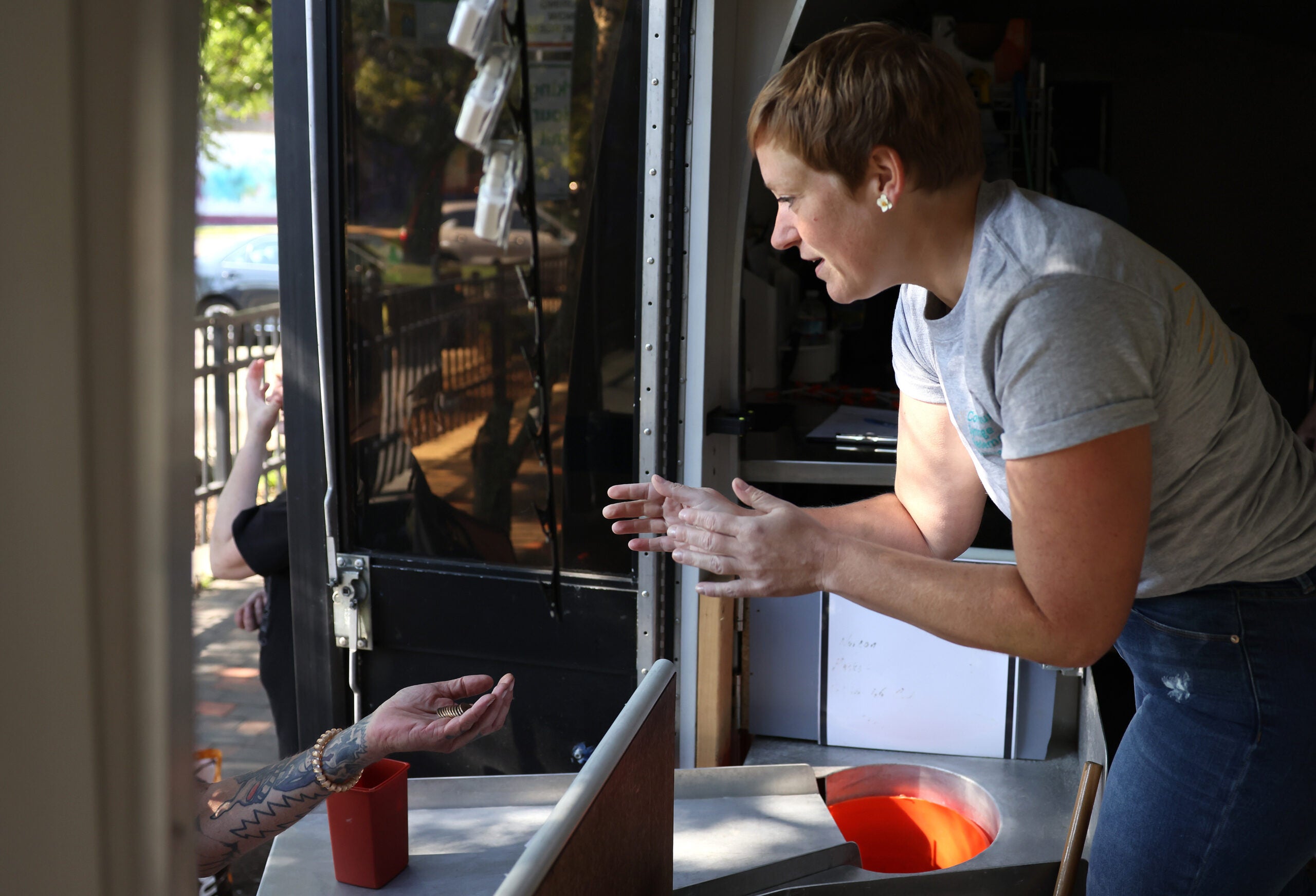
Allie Hunter co-founded Addiction Response Resources in 2020 as a passion project aimed at finding solutions to the problem of syringe litter.
In December 2020, the organization created the Community Syringe Take Back Program, a syringe buyback program that offers a cash incentive — 20 cents per used syringe and up to $10 per day — to registered adults to return used syringes.
The program’s initial goal was to collect 1,000 syringes per week. On its first day, it collected more than 2,000. During its four-and-a-half-year run, the initiative collected nearly 30,000 syringes per week and registered more than 3,000 participants, Hunter said.
“We deliberately work very early in the morning so that the streets are clean before people start going to work,” she said. “It’s kind of under the radar. It happens while most people are still asleep, and you wake up and the syringes aren’t there, and you don’t really know why, but it’s a positive thing.”
The mobile program previously had three locations in Boston — on Atkinson Street near Massachusetts and Cass, at Nubian Square, and in downtown Boston — but the city funding it relied on was limited. Unlikely In June 2024.
“It’s also been creating a sense of purpose and self-efficacy for people who are looking for that to help build the blocks of recovery in their lives, creating consistency and stability,” Hunter said. “It has had a positive impact on syringe waste, but then all these other positive indicators as well.”
Dr. Tracey Green, director of the Opioid Policy Research Collaborative at Brandeis University, said people struggling with addiction should have greater access to “services that treat them with dignity.”
The syringe buyback program is such a service, she said, one that should be recognized in Boston and that other cities should emulate.
“The environment benefits, the community benefits, the participant benefits. It’s like it’s hit multiple points along the way,” Green said.
She described the appropriate disposal of sharps as a broader public health infrastructure issue, beyond being a problem for drug users. People with diabetes or who use injectable treatments, such as fertility drugs or hormones, also generate sharps waste.
“An environment that is not conducive to seeking help may be more stigmatizing and often has more of these problems,” she said.
Despite progress and advocacy, stigma may lead people to hide their use and dispose of sharps in less ideal ways.
“Having the mindset that people still feel shame, and the importance of being able to design spaces with stigma in mind,” she said. “Getting the shot away is really thoughtful, not shameful, and people are responding to that in really important ways.”
South End officials: ‘Non-linear’ recovery model.
South End community leaders and city officials on February 18 announced a proposal addressing the issues surrounding Mass and Cass.
The proposed plan includes giving people involved in public drug use a choice between immediate placement into a recovery program or facing criminal charges, the group behind the recommendations said in a news release.
“We didn’t want to make it a win-lose situation. We didn’t want to make it about crime. We wanted to make it about getting people the help they need, which, as a side effect, would solve crime,” said Brand, of the Worcester Square Neighborhood Association.
“There is no good solution if there is a winner and a loser,” Brand said. “Everyone has to emerge better off for the solution to be permanent.”
Subscribe to our newsletter today
Get everything you need to know to start your day, delivered straight to your inbox every morning.