NEW YORK — In the days before the Westminster Dog Show, I could not stop saying the phrase, “33 Pomeranians.” There’s a pleasing rhythm to the phrase—better spelled out as thirty-three Pomeranians—that lends itself to any multitude of cadences. Excitedly: thirty-three Pomeranians! As matter-of-fact as one might say 101 Dalmations: thirty-three Pomeranians. Baffled and/or aghast: thirty-three Pomeranians?
This was, of course, because there were 33 Pomeranians in attendance at the Westminster Dog Show, though the Pomeranian participation metrics still did not quite match up to the delegations of Retrievers, Golden (52), or French Bulldogs (48!), or Chihuahuas, of both Long Coat (23) and Short Coat varieties (18). Which is a way of saying that there’s no getting over the absurdity of, as the official press release says, 3,000 CHAMPION DOGS FROM ALL OVER THE WORLD TO COMPETE AT THE HISTORIC 150th WESTMINSTER KENNEL CLUB DOG SHOW.
Champion, in this case, means a dog that has obtained at least 15 points in competition, with two major wins under different judges. The Westminster Dog Show is a competition of champions—to participate is to already be a winner, though of course there are always bigger horizons.
Though none of the champions got off the 7 train with me, the dogs entered the Javits Center as human beings do. I did see a civilian dog on a walk with its owner, not particularly interested in the proceedings. There was a big PETA billboard across the street, declaring: You can get a nose job. They can’t. DON’T buy breathing-impaired breeds and WHO TOOK MY NOSE?! Flat-faced dogs struggle to breathe. NEVER buy them. To my knowledge, none of the 48 French bulldogs can read.
One owner was stalled out on the sidewalk. Upon closer inspection, they were bending down to pick up some poop. Even champions shit.
Some of the research I conducted in preparation for the event included reading outsider-perspective dog show documentation (“God Dog”; “At Crufts”), watching Best in Show (2000), incidentally learning what the word “theriogenology” means while browsing the Westminster program guide, and flipping through various breed standards and immediately scrolling down to temperament. This final act of research in the toy dog group alone exposed me to such phrases as “gay and alert” (Chinese Cresteds), “an extrovert, exhibiting great intelligence and a vivacious spirit” (Pomeranians), and “a well-rounded ‘apple dome’ skull” (Chihuahuas).
It is important not to confuse the goings-on of the Dog Show with an agility or obedience contest. The Westminster Dog Show is for purebred dogs of the 202 breeds recognized by the American Kennel Club, judged in something resembling beauty-pageant fashion against their published breed standard. The daytime programming is for Best of Breed: 10 rings in a massive convention center running simultaneously to pick a winner for each participating breed (202 of them!), with the seven groups—sporting, hound, working, terrier, toy, non-sporting, and herding—split over two days.
Mutts are unsurprisingly not permitted entry, though they are allowed in the agility contest, where they are referred to as All-American Dogs. All-American dogs won the 12- and 16-inch division—Nimble and Iron Man, respectively, with Iron Man setting the fastest time of all dogs at the event, perhaps a symbolic victory for mutts nationwide.
The word bitch is indeed omnipresent at a dog show: SELECT BITCH on a board in a post-show photoshoot behind a Chihuahua; Sex: Bitch on the official results. During one judge’s presentation, after a Bearded Collie bitch he had adored was misgendered (missexed?), he came to her defense: “She’s very feminine, there’s nothing doggy about her.” Doggy, as a misandrist comment! May the judge and the Bearded Collie bitch forgive me if I use “dog” as a gender-neutral term.
No participant is spayed or neutered, as variously testicular French Bulldogs demonstrated to me early on day one. As Westminster is a conformation show, breeding stock is of great importance. Owners can trace their dogs’ grandparents, parents, aunts. A human declared to one Golden Retriever, “Your semen is now more valuable, buddy.”
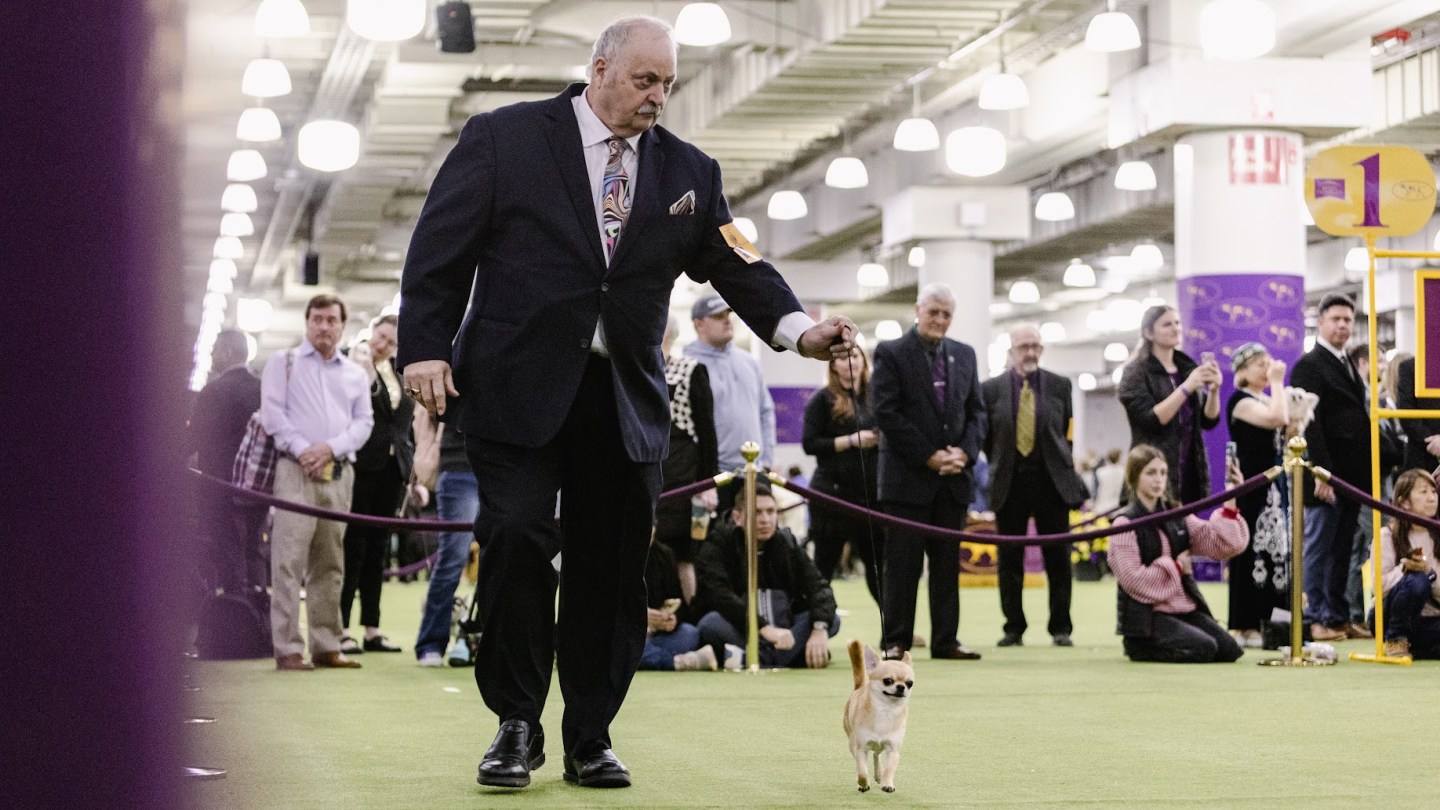
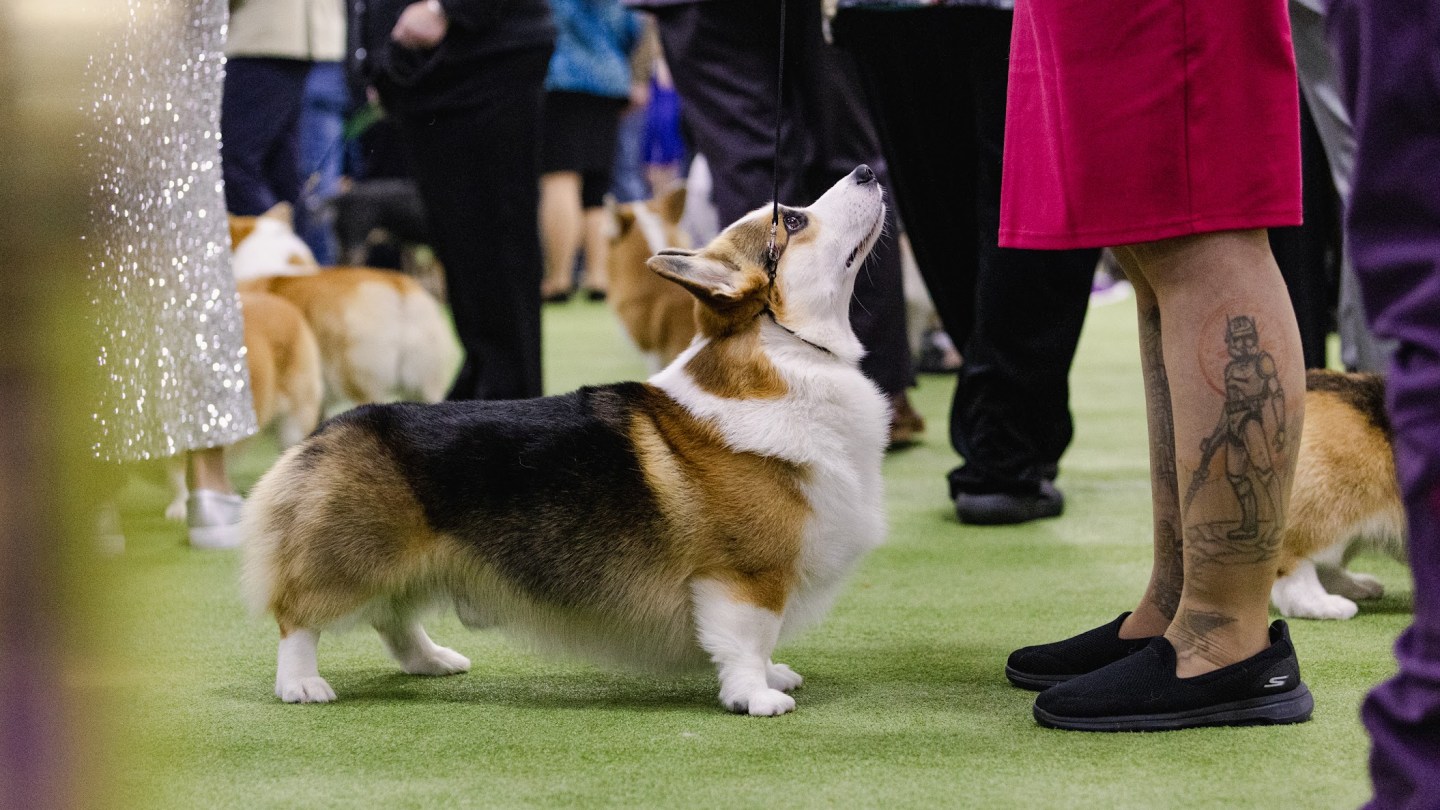
There was no in-ring commentary, so with my paltry knowledge viewing the proceedings became a pleasantly abstract experience. What makes for a good gait? Which of these dogs is, somehow, particularly beautiful? Is that Chinese Crested (the hairless variety, of which my sister maligned, “Those look like horses. Those look like ponies.”) particularly gay and alert? Is it a demerit when that Corgi barks, even if it isn’t aggressive? Is the sound of a Dogue de Bordeaux snuffling like it is nightmarishly congested a knock upon the specimen? Evidently not: said Dogue de Bordeaux won Best in Breed.
No matter the number of grand champions in the bloodline or quality of conformation, each dog in the ring was just a dog. A little jumpy at times, certainly food-motivated. Every trainer carried treats somewhere upon their body, tossing little pieces of steak across the ring to draw the dog’s attention in the right direction. The official event photographers had a squeaky toy that they threw to catch the winners’ profiles. And even as the morning events were put on hold so spectators could stand for the American national anthem, you could hear, in the distance, a chorus of barking.
The Westminster Dog Show is a bench show, which means that all the dogs are required to hang out in a large backstage area for the majority of the day, no matter if they have already been shown or not. The benching area is where the anthem barking originated, and it is a remarkable space for having dogs, everywhere, all dogs, more dogs than you could ever imagine, all different types of dogs in different states of preparation, including 33 Pomeranians.
This set-up makes dogs, handlers, and owners alike readily available for any attendee, reporters included. The intrepid media member may consider, and then discard, the possibility of raising the concept of “smelling like Fritos.” It did, however, smell crazy in there. To rephrase, it smelled like dog, or, to be extremely specific, it smelled like wet dog, likely thinks to a row of sinks with signs next to them that specified SINK DESIGNATED SOLELY FOR DOG AND GROOMING WATER USAGE.
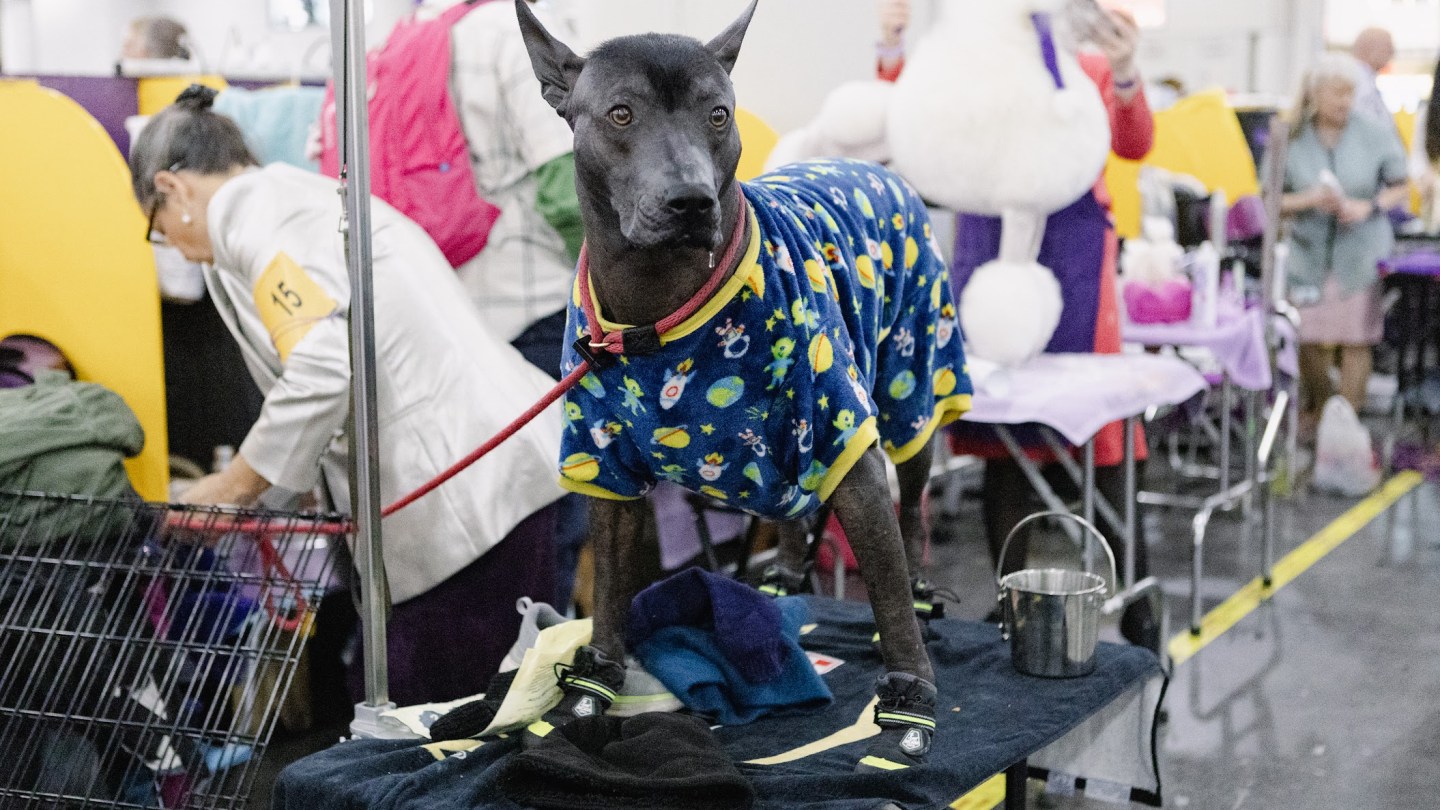
Pass through the benching area, and you may see: women with the formality of full hairdressers and salon-grade products carefully trimming the ass pompoms on several huge black Poodles; an arrangement of six sculpted Bichon Frises, just a series of black dots upon a cloud of white; a man applying red light therapy to a dog; a row of identically styled Bedlington Terriers, resembling Mary’s little lambs; one French bulldog sprawled upside down on her owners’ lap, snuffling, while her (full) sister did her own snuffling while pacing about; two extraordinarily dapper pugs; four Salukis of different colorways having their flowing pigtails arranged in front of a step-and-repeat. If the dogs are done showing, their owners may allow you to pet them, and you may experience such textures as: the thicker, coarser fur of a Corgi named Ricky Bobby; the knotted cords of a Puli, one of those mop dogs (the hair is only difficult to manage when they are babies); the soft mass of fluff of a Bernese Mountain dog that you can sink both hands into.
There are a couple other contributors to the particular dog show aromatics. In the hopefully waterproof and well-drained floor of the benching area I saw a streak of what looked—only vaguely, I convinced myself—like runny shit. A woman let another woman know that their dog had pissed on the floor by a potted plant. (Response: “I know.”) On the lurid neon-green floor of the dog show’s history presentation, a Boston Terrier—I think; some brachycephalic dog or other—paced about a man in a suit, who stood looking around for assistance: They were surrounded by three little brown turds.
The Nederlandse Kooikerhondje is better known to me as the breed of Shohei Ohtani’s dog, Decoy. There were only four entrants here, and all of them left with a prize. Despite circling the benching area multiple times, I was not able to find and speak to the winner, Breaker, and ask him if knew of Decoy or, for that matter, Shohei Ohtani.
Then again, a “dog celebrity” here does not refer to a human celebrity’s dog. Meet-and-greets with Westminster “legends” were a part of the official programming. The first was Monty the Giant Schnauzer, who was last year’s Best in Show winner. There was already a line well before 1:00 p.m., but Monty, the diva, was late. Was he perhaps tired out from his earlier sponsor appearance with Cosequin, which sells joint supplements for cats, dogs, and horses? 1:00 became 1:03, then 1:05. Monty only had a 30-minute time slot. Would he show? Then at 1:08, the celebrity appeared! He easily hopped upon the stage, then upon the platform, where he sat, patiently, and took photos with a line of attendees.
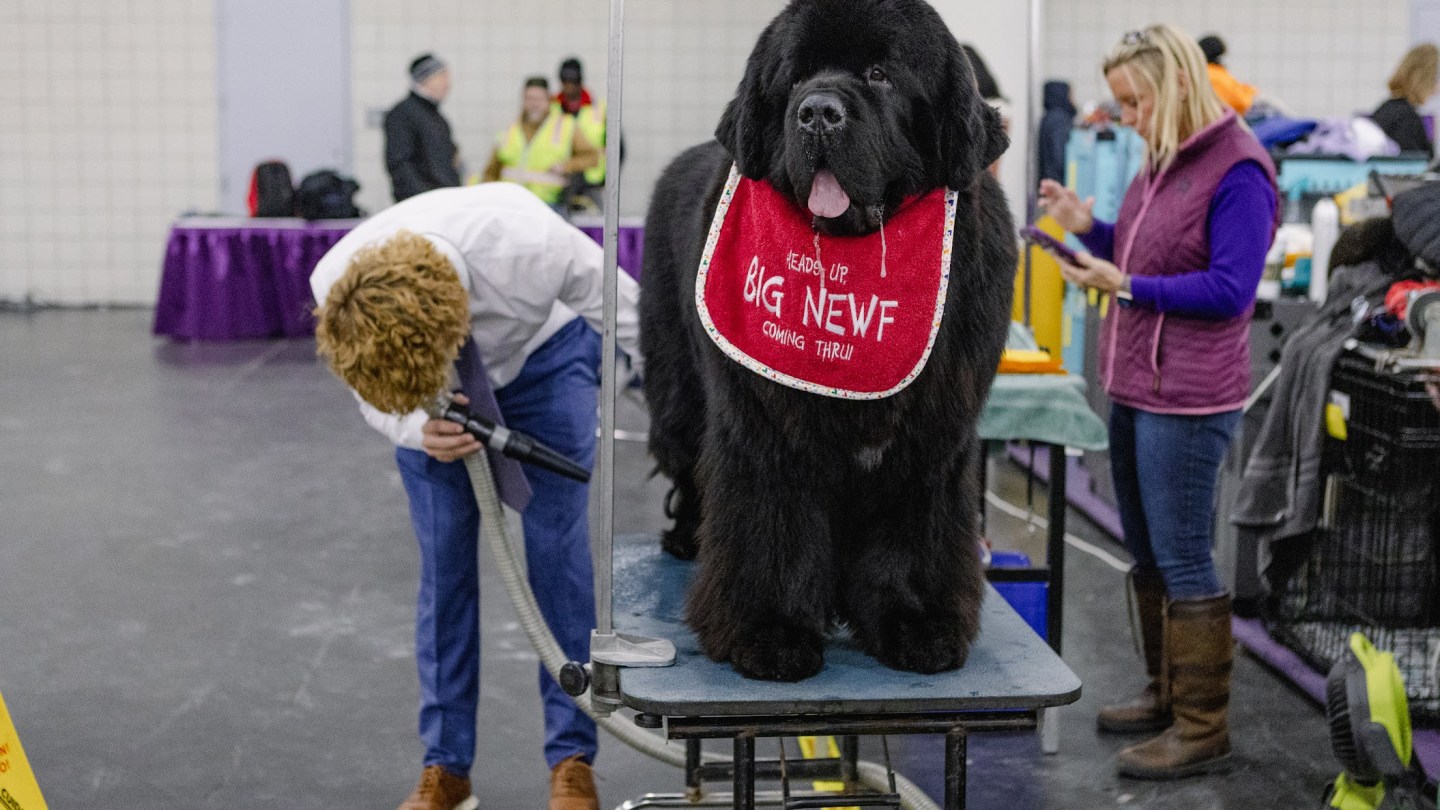
But every dog is a celebrity, and the big dogs are especially good at holding court. Seeing a big dog in person is not unlike seeing a plane wing on a flatbed truck on the highway; it inspires some base, Castle of Otranto–esque awe at bearing witness to a massive object. There was Peanut the Otterhound wriggling around from person to person (“He thinks everyone is here to pet him,” his person said, and Peanut was correct), and Panda the Saint Bernard sprawled out, half-asleep, with paws crossed and head resting on a barrel.
There are more blue-collar dogs: the working breeds. There were three Anatolian Shepherds in the ring, one of their handlers a young girl with a dog practically her size. The breed is a fierce livestock guardian and can face such predators as mountain lions—I caught the tail-end of one handler saying, “…on the farm, protecting his goats”—and yet confirmed kill count was not a metric in the breed’s evaluation.
Still, while the dogs were judged on fundamentally aesthetic standards, there was a great deal of give acknowledging the purpose of the breed. “Seasonal fading is not to be penalized,” the standard reads. “Broken teeth are not to be faulted.” No one would mistake this as standard similar to that used to evaluate, say, 33 Pomeranians.
And there I was, at 1:30 p.m. on a Monday, watching 33 Pomeranians be evaluated in Ring 3 and telling myself that this was for work. A bit disappointingly there weren’t actually quite 33 to be seen—a whole eight Pomeranians were absent. Outside the ready ring where the dogs waited to enter were portable grooming stations clustered about like strollers at the zoo. The Pomeranians entered the ring one-by-one, their handlers armed with a comb, at minimum; some additionally had what appeared to either be hairspray or water.
The Pomeranians were so fluffy as to be faintly unreal. The ideal posture had the dogs standing with their chests puffed out, looking up so their heads touched their fluffy tails, giving the impression of one indistinct, solid cloud. The dominant Pomeranian coloring was brown, though there was a substantial minority of black Pomeranians, and a couple cream or white ones.
I was fortunate enough to be standing next to a woman who had two Pomeranians of her own, one of whom was a retired champion that she showed me a photo of on her phone. It was apparently quite uncommon to see white Pomeranians compete, on account of the smaller bones. She told me that she preferred the teddy bear faces of to the foxier faces, which made them look a bit too much “like a gremlin.”
One of the Pomeranians had shooters: Number 29, handled by a man with a beret, paraded to cheers and whoops from the crowd. (Some spectators had a practiced sort of whoop—a two-parter, with the second syllable coming in at a higher pitch.) As the dogs rotated around the ring, 29 spent some time in front of us. The woman beside me marveled, “Ooh, he’s so proud. He knows. He’s like, ‘OK, ladies, look at me!'” At this point, I had evidently spent enough time at the dog show to start going insane because I found myself admiring his boastful little posture and thinking, Well, he does have a certain prance about him.
I stayed for the entire hour of judging. Throughout the process, my temporary companion picked out three Pomeranians she particularly enjoyed; all three received some kind of award at the end. It was the number 29 Pomeranian—call name “Aslan”—who went on to win the entire thing and, indeed, would go on to come second in the entire toy group. I later dug up the Facebook page of Aslan’s owner. He posted shortly after the nighttime group judging: Best night ever!!!!!!
I watched Free Solo the night before attending the dog show, which proved surprisingly relevant: Here I was, again, faced with some unfathomable psychologies. Zaida the Afghan Hound won the hound group, and her handler said, teary-eyed, “I will remember this for the rest of my life. She’s the one who makes me think anything is possible.”
It is easy to get exhausted over the course of the dog show. There are some shocking scenes that can burst through as a reprieve, like during the Samoyeds, when a woman ran her smiley cloud around the ring and lost her balance turning the corner. For a few seconds, the spectators knew what would happen before it did: The dog kept running, in spite of her stumbling steps, and she fell into the roped barriers at the side of the ring. People rushed to help her up. She was unharmed, and the show went on, her participation included—she simply discarded her shoes for the cause.
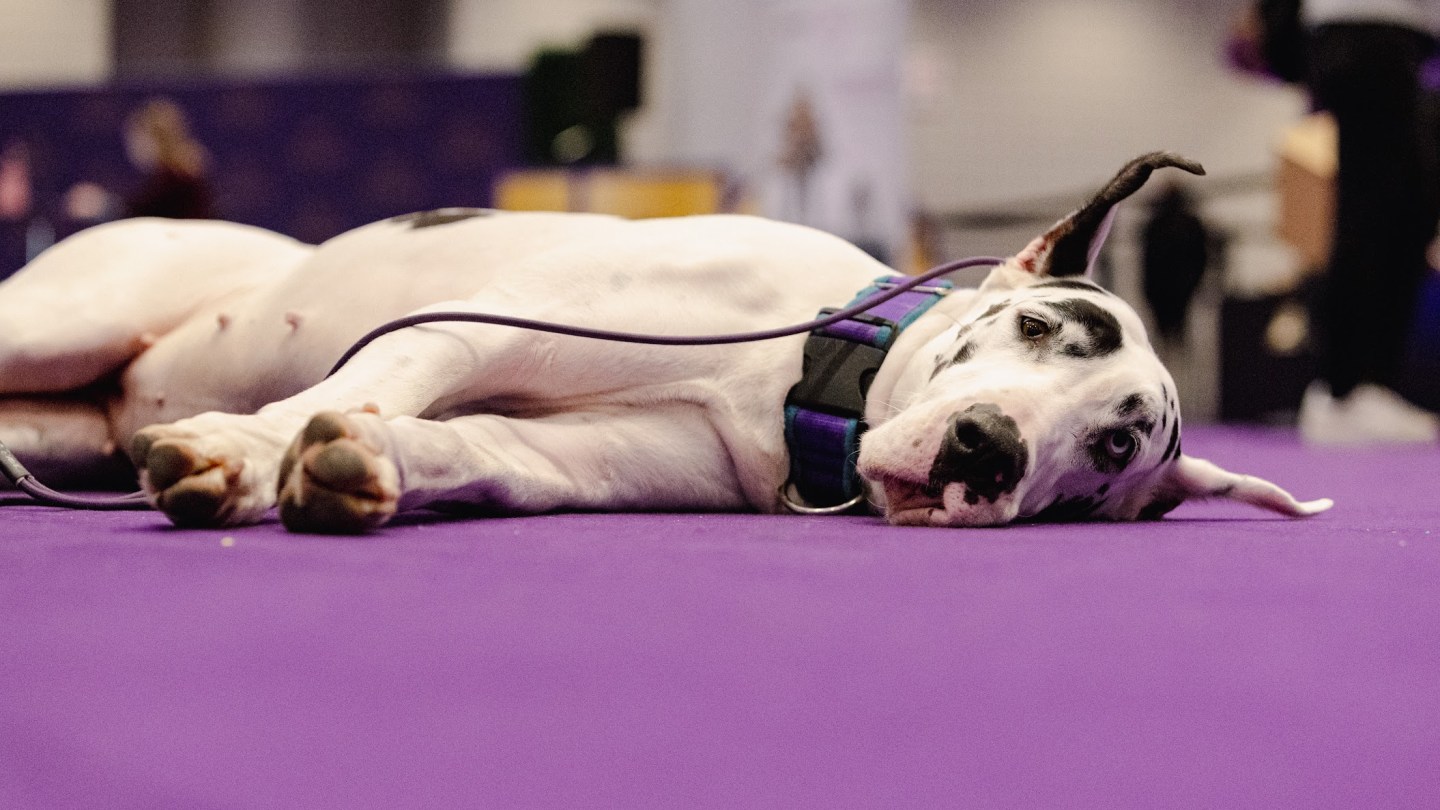
For the neonate, witnessing such a foreign process can wear quickly, like staring at an image for too long. The act of handlers repeatedly rearranging their dogs’ posture to get the most picturesque angulation of the back legs started off looking practiced and urgent, but then began to mostly appear desperate. In many ways, the inexpert attendee is the worst audience for this kind of event: a convention for people operating within a niche hobby to meet others who can understand them. An owner should much rather speak with other owners or breeders who can understand their language—someone who already knew what theriogenology means.
But regular scenes of affection help dispel the low-level ambient madness. A handler’s dog does not win a single prize, and he bends down to pet and congratulate and kiss her head anyway.
After the Pomeranians are judged, a little man named Magic was sprawled out atop his crate, a mass of floof with a tiny nose poking out. He was very, very soft. Magic didn’t win a prize, but his owner was still delighted to chat anyway. She is 83 years old; she has been doing this since she was 7. The oldest handler to show a dog at Westminster was 85, so she has to make it two more years.
“He’s all tuckered out from a long day at work, huh?” I asked.
“Oh, yes, he’s had a long day,” she said. “And he misses his Border Collie brother. They love each other.”
Does a Pomeranian understand the stakes of competing against 32 other Pomeranians? It is easier to enjoy the dog show if one believes that the dogs at least enjoy the experience, if not quite experiencing some form of competitive zeal. Is it not a dog’s dream to have thousands of people adore them? The owners are eager to say that it is. Their dogs love the attention; they think everyone is here just for them. And when a Nova Scotia Duck Tolling Retriever named Brie falls back on her owner with tail wagging, it’s easy to believe.
Perhaps a dog show is just the sort of thing that happens when loving your dog also becomes your job. Is there better validation for your own best boy or girl than being formally judged the best of them all? And if that means you can now charge more for their semen, well, that’s just gravy.