Local news
After a sudden stroke left Rich McMahon unable to speak, his wife turned his daily coffee routine into speech therapy.
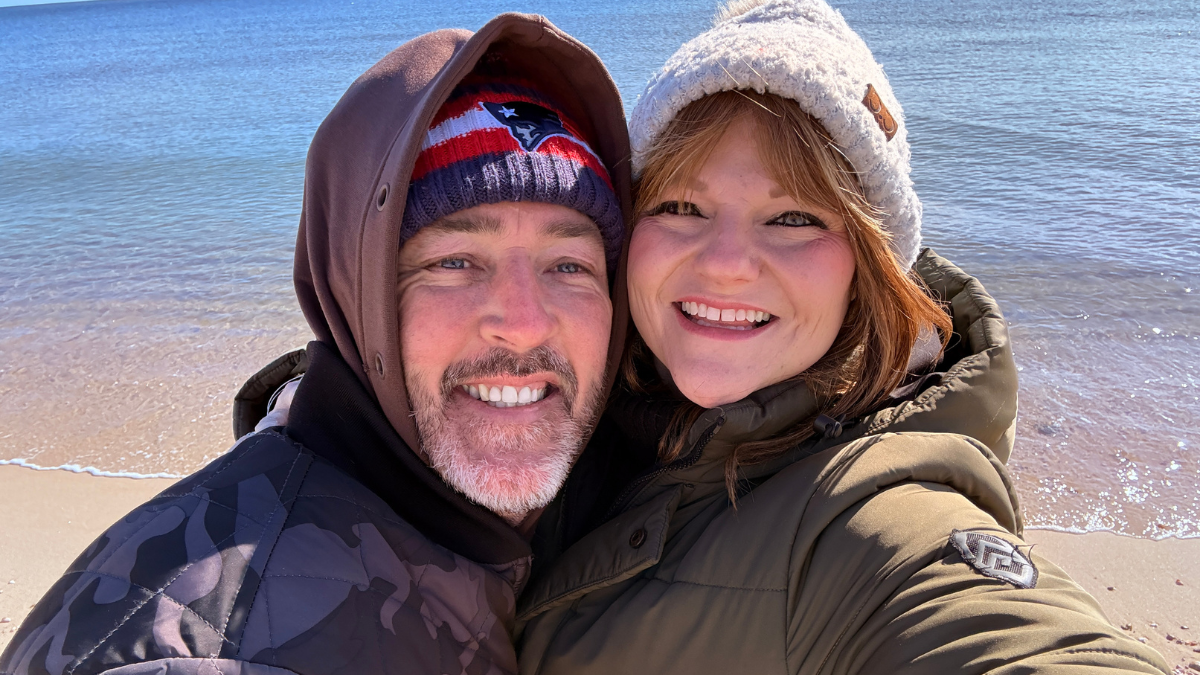
Rich (left) and Liz (right) McMahon from Cranston, Rhode Island. (Photo courtesy of Liz McMahon)
When Richard McMahon began relearning how to speak after suffering two strokes, the words he practiced weren’t taken from a speech therapy textbook, but from his own Dunkin’ command.
Every day, sometimes hundreds of times, he repeated the familiar phrase — the same coffee order he’d recited on countless mornings before October 2025, when a sudden stroke changed everything: one big iced coffee, two creamers, two sugars.
For his wife, Liz McMahon, a little routine has become a powerful sign of recovery.
“It’s not just his Dunkin’ order, the rest of his language has improved significantly,” she said.
The stroke no one expected
Liz and Rich McMahon built a life together that seemed destined from the moment they met a decade ago at Novara, an Italian restaurant in Milton, where they both worked. He was the kitchen manager. She was the bar manager.
“I knew it right the minute I shook his hand,” Liz said. “I literally thought, This man will ruin my life“And he was definitely up for the challenge,” she added.
The two married in their backyard in 2019, with their young son serving as best man.
Then everything changed last October.
Rich, then 53, had just launched a mobile detailing business. One morning, while working on a customer’s car, he texted Liz with an unusual question.
“Can you Google what it means when you have a light flashing in your eye?” I remembered him writing.
He said that moments ago he felt pain in his neck. Suddenly it was “as if someone turned a flashlight on and off.”
Liz initially suspected she had an ocular migraine. However, Rich drove himself to the emergency room at Kent County Hospital in Warwick — “just to make sure I wasn’t having a stroke.”
At first, emergency room doctors thought it was just that: ocular migraine. But while Rich was waiting to be released from the hospital, his symptoms worsened. His entire right side became numb.
Doctors took him back to the emergency room and discovered the cause: a dissection of his carotid artery, a tear in the artery wall that led to blood clotting and blocked blood flow to his brain.
After receiving clot-busting medication, Rich was transferred to Rhode Island Hospital for observation. Lees was told he had suffered a minor stroke with no damage to his brain and would likely stay out through the night.
Gloomy forecast
Shortly after arriving at Rhode Island Hospital, a second clot ruptured, causing another stroke.
Emergency surgery removed the clot from his brain through thrombectomy.
When Liz arrived at the hospital, she did not yet realize how serious the situation was.
“I went in and it was more serious than I first thought,” she said.
A neurologist warned her that Rich might never walk independently again and would likely never regain normal speech.
“I didn’t expect to be able to have a conversation with him like you and I do,” Liz recalls the doctor telling her.
Her reaction was immediate.
“No,” she told the doctor. “I don’t accept that.”
First word
After several days in intensive care, Rich was transferred to Newport Rehabilitation Hospital. On the acceptability scale, which measures cognitive and physical function, he scored three out of 100.
He couldn’t speak. His right side was largely immobile.
One afternoon, his son pointed to the whiteboard in the hospital room. She wrote three simple words: We love you.
“Dad, can you read what the council is saying?” He asked his son.
Rich uttered one word: “We.”
“For the next few days, it became a giddy repetition of, ‘Us, us, us,'” Liz said. “Eventually I said, ‘Okay, we get it,'” she added, laughing.
But that one word was the beginning.
Within days he started counting out loud. Soon after, his mobility began to improve.
“Nothing, nothing, nothing, and then it just kind of blew up,” Liz said of his progress.
Dunkin’ as a treat
As Rich’s speech slowly returned, Liz looked for ways to make language practice feel natural.
Before his stroke, Rich rarely spent a day without stopping at Dunkin’.
“He got Dunkin’ every day,” Liz said. “It was just a big part of his routine.”
So they turned her into speech therapy.
“Day 1 of practicing our Dunkin’ thing to be a spokesperson,” Liz joked in a video on her TikTok page. Chaos to return.
@chaostocomback Its name is manifestation, search for it 😂#StrokeSurvivor #stroke #Strokes #aphasia ♬ Monkeyshine-JP – Lieutenant Fitzgibbons Maine
She initially shared the clip in January as a personal record of his recovery. In the months since, videos now show Rich repeating it — sometimes stumbling, sometimes laughing — while slowly regaining clarity and confidence.
“It’s really a measuring stick,” Liz said. “If you watch day one and you watch day 30, the progress is unbelievable.”
What surprised Liz most wasn’t just the viral attention, it was the kindness.
Speech therapists, stroke survivors and caregivers from around the world began sharing their own stories.
“We found the one positive corner of the Internet,” she said. “Not a single negative comment.”
Meanwhile, Rich – whose wife once described him as someone who “never met a stranger” – is slowly returning to his old self.
Talks are still taking some time. One time, Lees said, it took him nearly 40 minutes to explain that Drake’s wife May looked like a relative of his.
But Liz says they’ve learned to laugh.
“If we choose to feel down, we will feel down all the time,” she said.
Instead, they keep practicing — one coffee order at a time.

Subscribe to our newsletter today
Get everything you need to know to start your day, delivered straight to your inbox every morning.