As Cardte Hicks leapt toward the hoop, the audience at the Albuquerque Civic Auditorium suddenly hushed. These were the final minutes of the Women’s Professional Basketball League’s All-Star Game on Feb. 9, 1981, where an undersized squad from the West was blowing out the favored East team in what would be a 125-92 win. The arena grew rowdier as the quick sharpshooters of the West racked up points, but when Hicks alone flew above the rim, the crowd went silent.
Hicks, a 25-year-old All-Star from the San Francisco Pioneers, was unlike any other player on the court. At 5-foot-9, listed in some places as 5-foot-8, her vertical leap was reported as high as 36 inches. Word of her talent had spread across the WBL, the tale growing taller. “She’s up there so long, she can dial a telephone number,” Pioneers teammate Roberta Williams would tell me decades later. “Say hello, and before the conversation’s over, say goodbye … I never saw a female who had the kind of hang time she had.”
With the clock winding down, this gave West head coach Greg Williams the idea to encourage Hicks to try something she’d never done in a WBL game before: attempt a dunk. “She was such a graceful athlete,” he remembered. “Almost poetry in motion.” The coach had total confidence in her abilities. “You go up there and play the way you wanna play—just shake ‘em!” she recalled him saying. Hicks, known for her impressive vertical and magnetic charisma, was more than ready.
What no one in Albuquerque knew then was that the 1981 WBL All-Star Game would be the last event of its kind in the United States for the next 15 years. There was no way to envision how the impending void of any sustainable women’s pro league in the U.S. would swallow the potential of thousands of elite women basketball players. For the next decade and a half, so many burgeoning pro careers would be shifted overseas, left untranslated and off camera.
The same fate awaited Hicks. Years after the All-Star Game, she’d live in Europe, competing at the highest levels. But that February evening in 1981, Hicks was peaking in front of American audiences. On the next play, as the defense sagged back, “she goes flying in,” Greg Williams said. “And she’s definitely got her hand above the rim.”
Then, at the last moment, the ball slipped from Hicks’s grasp. As her hands clutched metal, the leather orb bounced off the back rim, clanging away from her. The crowd of over 3,300 sat stunned, according to the coach. Then the room erupted. “Everybody’s slapping high-fives and yelling and cheering,” he recalled. Hicks may not have finished the dunk, but the attempt itself was a moment of pure jubilation.
Speaking to Hicks now, it’s as if she came out of the womb hanging from the rim. “It was never anything,” she would often say whenever I asked her about dunking. Hearing this, I grew fascinated by the legend of her All-Star almost-dunk, especially in an era when it was virtually unheard of in the women’s game. More broadly, I wondered how it was that by the time Hicks began a brief pro career in San Francisco, she had already developed such confidence as an openly queer African-American woman. Why had I never heard of her talent or personality, decades before the WNBA was imbued with that same unapologetic, progressive coolness?
It’s because the career of Hicks, like many other women’s basketball players of her generation, would remain frustratingly obscure.
I met Cardte Hicks in person in July 2025, at the first San Francisco Pioneers reunion in the Bay Area since the team folded in 1981. As the city’s original pro women’s basketball franchise, and an expansion team in the short-lived WBL, the Pioneers ceased operations so suddenly that players weren’t even able to say goodbye to one another. Until the summer of 2025, they’d never been publicly honored by the WNBA. But the former team was adamant: They wanted to be part of the Golden State Valkyries’ inaugural season. When the WNBA’s expansion team invited the Pioneers to their History of Bay Area Women’s Basketball theme night on July 14, nine former players, including six who flew in from across the country, gathered in San Francisco.
“Oh, I’m gonna see my girls again!” Hicks practically sang to me that morning.
The day before that Valkyries game, we had gathered for a Pioneers reunion party I both reported on and helped organize, hosted at Rikki’s, a women’s sports bar in San Francisco. Hicks walked in wearing a black Adidas tracksuit and baseball cap, beaming. Standing at a very reasonable 5-foot-9, it was hard to imagine her hovering above a basketball hoop. But her long arms extended as she called her teammates together, gathering group hugs. Once the team settled around a big table filled with drinks and snacks, all of the women—now in their late 60s and early 70s—began the traditional athletic ritual of razzing each other.
Former Pioneers center Cindy “Stretch” Haugejorde took the microphone for toasts, circling around her teammates. Stopping at Hicks, Haugejorde said, “Now this person—sorry, Molly, I’m really sorry …” This was a playful dig at Molly Kazmer, then “Machine Gun” Molly Bolin and by far the most famous player from the team, who joined the Pioneers for the last few months of their final season. Kazmer was always a scoring threat in the WBL, holding the league record for the most points in a single game with 55. But standing behind Hicks and next to Kazmer, Haugejorde squeezed Hicks’s shoulders instead. “Sorry,” she said, “but this is my favorite player. … I sat there at the first practice, and Cardte went up for a rebound. And then … she grabbed the rim instead—with both hands! I’m serious!” The whole table broke into laughter.
The WBL’s three-season existence, from 1978 to 1981, was full of historic accomplishments as well as painful disparities among players. While the league was a dream come true for many, its athletes also experienced a wide range of uneven infrastructure and treatment. Some women went for months without pay, had to practice outside, or faced racial discrimination when looking for housing. This was also an era when the national media darlings in women’s basketball were white: former UCLA standout Ann Meyers; “cream of the crop” and top-salaried player Nancy Lieberman; and Faye and Kaye Young, twins who famously featured in a Dannon low-fat yogurt commercial, one of the first national ads to showcase professional women’s basketball players.
“If anyone should have been the marketed player, it should have been Cardte,” Roberta Williams, a rookie for the Pioneers during the 1980-81 season, later told me. “I feel that Cardte should have been the face of the WBL, with her talent, with her grace.”
Unlike the heralded white stars who were considered faces of the league, Hicks played the more utilitarian role. Head coach Frank LaPorte described her to the San Francisco Chronicle as “a super athlete.” Hicks was one of only two players to spend both full seasons with the Pioneers, though her first was marred with injury. Coming into her second, her All-Star season, Hicks told the press, “Magic is back.”
“They call Nancy Lieberman ‘Magic,’” the San Francisco Chronicle quoted Hicks as saying in the fall of 1980. “But there are only two Magics in the world—Magic Johnson and Cardie Hicks.” (Aside from her preferred nickname of “Magic,” Hicks also went by her given name Cardie at the time, though she would change it to Cardte in the mid-1990s.) “This is the last year on my contract with the Pioneers, and I hope they have the money to keep me because I’m not making the money Nancy Lieberman is,” she added. It was true: Reports claimed that Lieberman made $100,000 during her first year in the WBL with the Dallas Diamonds, compared to the average player salary of about $10,000. But Hicks was confident she could match Lieberman’s abilities.
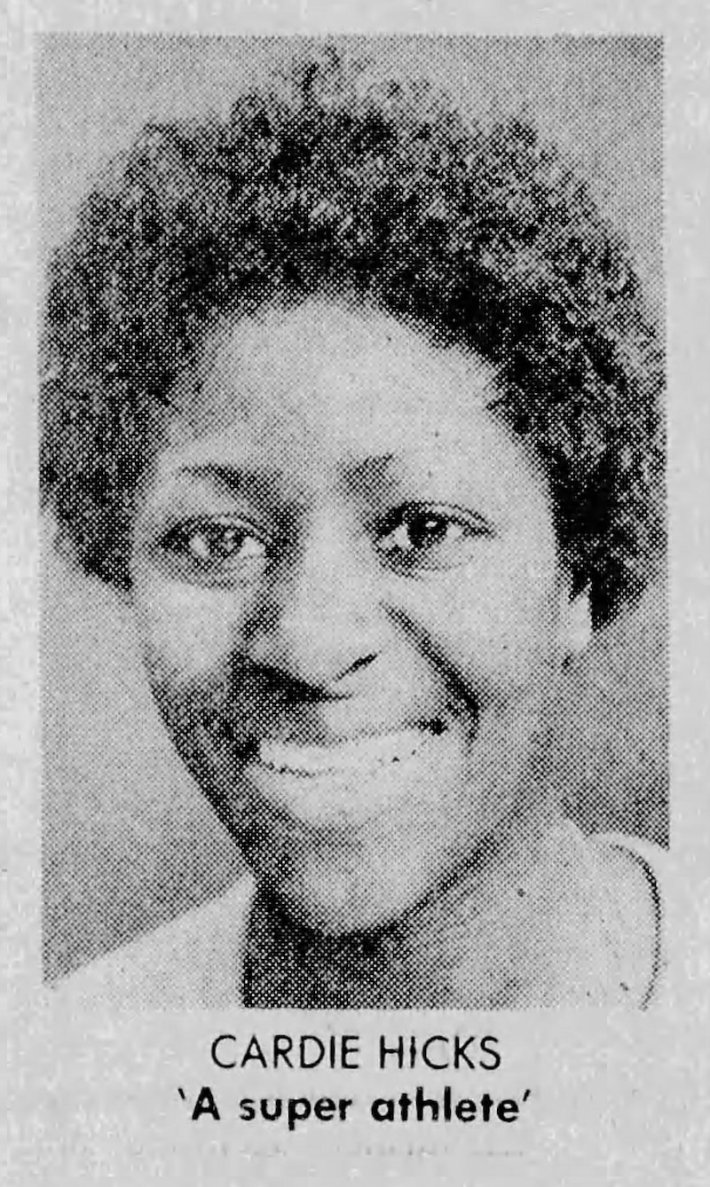
Throughout her time in San Francisco, Hicks was unapologetically herself. She loved the city, its culture, the beat of the Castro: “That bump, bump, you feel it wherever you are, you can’t stop moving.” She said she’d go out to lunch with future San Francisco mayor and former Pioneers part-owner Willie Brown—“Uncle Willie”—and rock her afro while strutting out on the court for games: “Girl, I looked good.” She reportedly sang the national anthem, a capella, before a game during the Pioneers’ first season. And she didn’t care much for male fans who treated the WBL as a novel way to hit on women. “I get approached all the time by men after the game,” Hicks told the San Francisco Examiner in 1979. “Many of them I feel are chauvinists … for me, the game makes me feel like I’m accomplishing something.”
Indeed, Hicks moved with rare finesse. “She could play in any type of game, and she could make her teammates look amazing,” former teammate Anna Johnson told me. Roberta Williams put it this way: “She knew who she was. And she loved who she was.”
As Magic, Hicks wanted to stand out. But her career, like those of many other African Americans in the WBL, was also marked by the effects of systemic racism. This was something that went rarely acknowledged at the time, an era remembered more for striving toward equality for female athletes in the U.S. But racial integration in the sport, yanked into rapid evolution following the enactment of Title IX in 1972, remained an uncomfortable topic. It also meant that coming up as a Black women’s basketball star in the 1970s was an experience that often made Hicks feel distinctly alone.
In high school, Hicks selected No. 10 as her jersey number, a quiet message to herself. It meant “one and only.” In other words, she was the only African American on the team. She never had a choice but to embrace being different.
Hicks was born to Jim and Mary Hicks in San Pedro, Calif., an industrial enclave of Los Angeles lined with jagged cliffs shaped by unrelenting ocean waves. She came from a large, religious family with five brothers and two other sisters, crammed together in a two-bedroom house. They were close: church-goers, singers, storytellers. Hicks would listen as her grandmother told stories about enslaved relatives who helped build the White House. In 1968, the family was rocked when their father died. Cardte was 13 years old at the time.
“You’re gonna be very, very needed.” Hicks remembered Jim, a preacher, telling her before he died. “You’re gonna be so different.”
Indeed, she stood out: a 7-year-old playing basketball with the boys, first with a bicycle frame nailed to a telephone pole as a makeshift hoop in the alley, then in playgrounds across San Pedro. Her mother worked such long hours at the fish cannery that she never saw her child play. “She just knew I was a tomboy out there beating all the boys in the neighborhood.” Nonetheless, Mrs. Hicks kept an eye on her youngest daughter. When Cardte explained that a neighbor was continuously harassing her with homophobic slurs, her mother remarked, “Well, you got a good arm.” Inspired by her mom’s comment, Hicks said she started carrying oranges in her pocket, hurling them at the woman’s rocking chair when she screamed her insults, until she “knocked her right off.”
Even though she had a sense of her own queerness from a young age, Hicks didn’t have any gay role models in her family or conservative church community. “I didn’t know anything about gay life,” she said. Nonetheless, her older sister Mary, the most supportive of her siblings, would tell her, “Don’t let nobody tell you nothing. You just continue to be you.” And so she did.
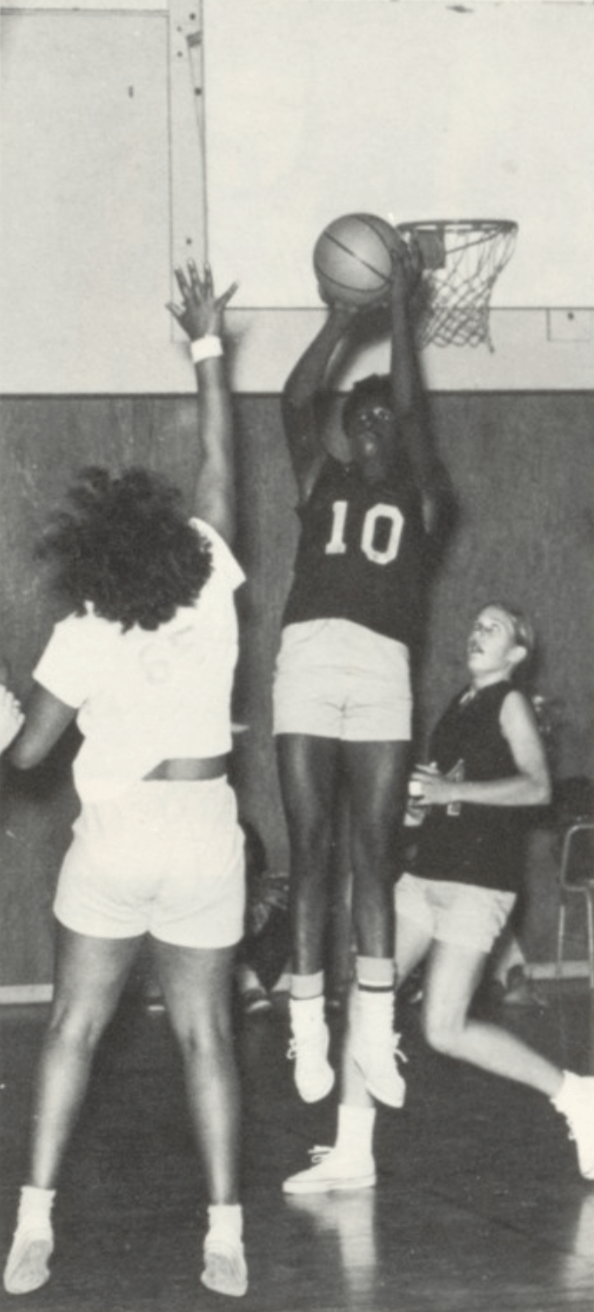
During those years, basketball became an “escape from it all” for Hicks. In 1971 and 1972, she led San Pedro High School to the city championship twice, playing a fluid, “off-the-cuff” style of basketball that head coach Maureen Hosier still remembers clearly today. “[My players] were beautiful,” Hosier told me. “I cannot tell you how beautiful they were.”
Hicks kept building her confidence. She said her brothers would drag her to different neighborhoods on the city bus, promising young boys cash if they could beat their kid sister—or else hand over their sneakers. “Sure enough,” she said, “my brothers always had the best shoes.” She’d practice all day and night at Peck Park, the ball rolling methodically from her fingertips, springing to the rim in the pitch darkness. She said neighbors would often pass by and stop to watch, expecting great things from their local hooper, wondering if one day she’d reach the Olympics.
“I had the ability to move my body and do things with it that ordinary girls couldn’t do,” Hicks told me. “Or they could do it, but they didn’t know how to do it.” Often she’d grab the rim, swinging for fun as if it were second nature. “It’s like eating your favorite hamburger.”
By 1976, Hicks was a junior at Long Beach State University, once again the only African American on the team. “I put a lot of pressure on myself,” she told me. “Being gay and then being Black and being poor. But I wanted people to accept me for what I could do.”
Hicks’s teammates saw greatness in their star player. Cathy Fisher, Long Beach State’s point guard and captain at the time, recalled Hicks as both “effortless” and “humble,” as well as unquestionably the best player on the team. “Her footwork, her coordination, everything … she knew the game. Her shot was just pristine,” Fisher said. “The shock and awe, it just became normal. To see her go up for a rebound, to see her arms going up and the ball just slapping into her hands—she was a woman among girls, a man among boys.”
With support from Defector’s Dan McQuade, I combed through newspaper archives from 1973-1976 at Long Beach State, eager to find details of Hicks’s impact on the court, but reports were sparse, squeezed underneath longer writeups of the men’s basketball team. One story from 1975, headlined “Long Beach has another power,” called her “the team’s best jumper,” and also included this gem of a line: “She has been called for goaltending already this season, an almost unheard of happening in women’s basketball, particularly for a player of her size.”
Off the court, the Long Beach State team was notably close. Hicks delighted her teammates with comedic impersonations, singing skills, and an “infectious personality,” according to Fisher. The two women whispered dating encouragement to each other and frequented a lesbian-owned establishment called Que Sera, where a then-unknown Melissa Etheridge performed in the dark, windowless bar in the ‘80s. Hicks was so confident as a gay woman at the time that she even inspired her opponents. “Cardte was different, too. Man, she was out—outright gay,” former UCLA captain Karen Nash told me. “During that time, when it was considered so taboo … she was so confident.”
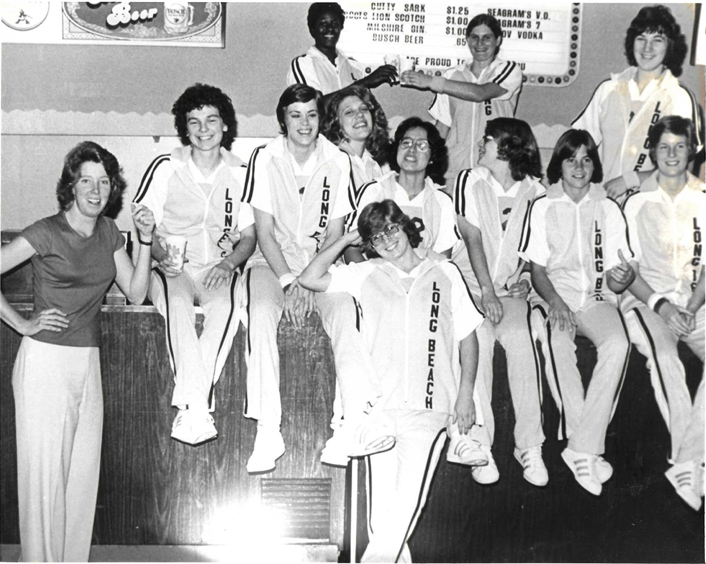
Despite chemistry with her teammates, Hicks faced a new challenge at the collegiate level: coaching. Unlike her high school coach Hosier, who encouraged the team’s flexibility and flow, Long Beach State’s Fran Schaafsma had a more structured approach. It didn’t mesh well with Hicks’s ability to read the court in motion, as a master of the fast break and a dynamic, positionless scorer. “[Schaasfma] did the best she could do,” Fisher remembered. “But she was limited. I don’t even think she knew how to run a motion offense.”
By 1976, Schaafsma had already been at the university for 14 years, the only women’s basketball coach the program had ever known. She was clear about having her players fit into her system. “I tell them this is the framework within which we’re playing,” Schaafsma told the Long Beach Press-Telegram that year. “I can understand if they lose their temper, but I also try to encourage them to modify their behavior.” Indeed, structuring offense through set plays was de rigueur at the time, especially in Southern California, then the source of perhaps the most influential basketball coach: UCLA’s John Wooden, who had retired a year prior.
Meanwhile, the players at Long Beach State sometimes pushed back on Schaafsma’s Wooden-inspired coaching style. “As a team, [Schaafsma] never even said, ‘Run this ball,’” Fisher said. “But as a point guard… if it came out to me and Cardte was open, I was giving her the ball. We knew she could take it to the hole, she could pop from midrange, she could pop from long range. We knew. Or at least I knew. And I had the utmost faith in her.”
While Long Beach State dispatched USC and UCLA with relative ease, their biggest competition during the 1975-76 season was the Cal State Fullerton Titans, led by head coach Billie Moore, a close disciple of Wooden. “Billie Moore was so headstrong and so determined and so structured,” Fisher told me, remembering how tense the games would get. “[Fullerton] had Billie Moore and they had the strategy. We had natural abilities … We’d just run and run and run … and we were tight, we were together.”
In February of 1976, Long Beach State lost a close one to Fullerton, 64-60. Though Hicks led her team with 16 points, opposing center Nancy Dunkle put the game away by scoring 16 of her game-high 20 points in the second half, leading Moore’s “Toast of the Coast” program to victory. But that wouldn’t be the last time Hicks and Moore would cross paths.
In May of 1976, Hicks was selected to join the final tryout for the U.S. national team, which would go on to win a silver medal in Montreal during the first-ever Olympic women’s basketball competition. That performance would help make household names out of players like Pat Summitt (then Pat Head), Ann Meyers, and Nancy Lieberman, though the team’s top three scorers were Lusia Harris, Nancy Dunkle, and Patricia Roberts. The 1976 squad was enshrined in the Basketball Hall of Fame in 2023.
Months before the team’s podium finish, Hicks flew from California to the final tryout in Warrensburg, Missouri. It was led by Moore, recently appointed the Olympic head coach.
Hicks was reluctant to talk about the tryout when I asked her, but I got a glimpse into that weekend in Missouri through Inaugural Ballers, a historical non-fiction book for young adults and by far the most comprehensive account of the 1976 Olympic team. Author Andrew Maraniss conducted interviews with most of the players and coaches who participated, including Hicks and Moore. He described the atmosphere as a gantlet commanded by the coach: “With no time to waste, Moore made the most of every minute in camp, putting the players through two or three grueling workouts a day.”
Moore was relentless in her vision for the kind of team she wanted. “She told her players they would all need to become interchangeable chameleons, willing to do whatever was in the team’s best interest,” Maraniss wrote. While she denied having an official vote on the Olympic selection committee, Moore also claimed to have directly recommended Lieberman as the final addition to the team. (At the time, Lieberman was just 17 years old, described in Inaugural Ballers as “still so immature and full of energy, she continually irritated the other women.”)
Maraniss described Hicks as “one of the most intriguing athletes at the tryouts” and “a phenomenal leaper.” But despite Moore’s close familiarity with one of the greatest foes of her own collegiate squad, she wasn’t a fan. “They didn’t like it,” Hicks told me. “I mean, I played too much like a guy.” She said the same thing when describing the tryout in a San Pedro News-Pilot feature from 1979: “My moves are very unusual. Most women players are more feminine in their moves.” According to the article, “the Olympic coaches tried to change her style, and she admits she rebelled.”
By the end of the weekend in Missouri, the Olympic Committee posted the final list of names on the wall. Players bolted from their rooms to the hallway of the shared dormitory to see the results. According to Maraniss, when Hicks emerged, “she was stunned to see her name only on the alternate list, believing she had earned a roster spot but had been denied because she was Black. Rather than continue as an alternate, she confronted Moore with her theory and asked for a ticket home.”
I spoke to Hicks about this moment, too. “I went to the office,” she said, “and I told them, ‘I wanna leave this trial. I don’t feel like I belong here or that you want me here.’ And instead of [the coaches] saying ‘That’s not true,’ they said, ‘OK, we’ll get you on the next flight.’” In Inaugural Ballers, all three of the former coaches interviewed—Sue Gunter, Bessie Stockard, and Billie Moore—denied that race was a factor in the roster construction.
But Hicks wasn’t the only one who believed race did have an impact on roster selection. Maraniss noted that two other African-American players, Althea Gwyn and Michelle McKenzie, were “certain a limited number of Black players would make the team.” Gwyn, who died in 2022, would go on to have a venerated career in the WBL before playing abroad in Europe and becoming Hicks’s close friend. I called up McKenzie, who lives in Albuquerque, N.M., and she remembered the tryout well. That spring, she had dropped out of college for a semester to train for the Olympic trials. When I asked her about the racial makeup of the weekend in Missouri, she responded, “I was used to seeing a sea of white anyway.”
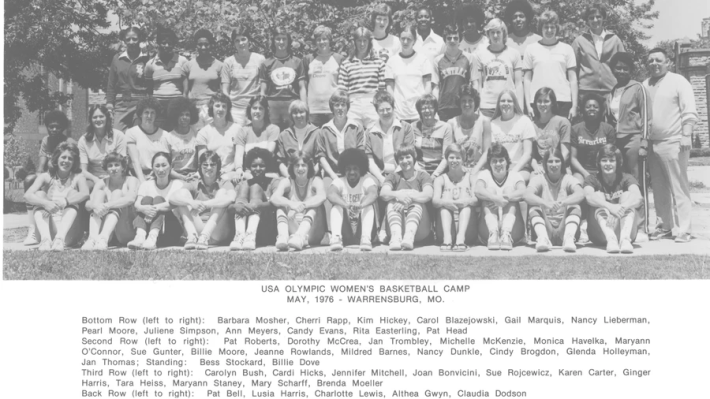
McKenzie also spoke of the difficulty of balancing basketball while hiding her identity at the time. “During those days, there were a lot of people that were in same-gender relationships, but we had to keep it on the down low,” she said. McKenzie had recently dated her first girlfriend while preparing for the Olympics with an AAU team in Milwaukee. “There were so many things that we were trying to juggle at that time. On the outside, we were trying to fit in, and on the inside, all your feelings and connection and validation held inside.”
McKenzie remembered Hicks as one of the athletes who was “in sync” on the court. In a tryout with so many talented players, “the game is in flow.” After being named an alternate like Hicks, McKenzie was disappointed but told herself, “They gotta do what they gotta do, fine and dandy. I had to justify it.” And yet, she said, “Cardte was known to the coaches in that part of the country, and she did well in the trials. The question is: Why didn’t she get picked?” Looking back, McKenzie told me, “I think Cardte was the one who realized this is a bunch of crap and they discriminated against us.”
Not long after the Olympic trials, Hicks suddenly left Long Beach State. In 1979, she told the News-Pilot that she changed schools for academic reasons. When I asked her about it, Hicks didn’t provide one distinct reason, but referenced the tension between basketball and her identity as a queer Black woman.
“You gotta understand, when you’re living a certain lifestyle,” Hicks said, “and you’re dealing with being the only Black person, you got so many strikes already against you.” The decision to leave Long Beach State was abrupt and full of frustration. Hicks referenced trauma in the family around that time, and her desire for different academic offerings, but was hesitant to elaborate. She did, however, linger on one thing being true: “I didn’t take the time to express my feelings to the coach.”
To this day, Hicks regrets leaving without speaking first to the coaching staff or her teammates, like Fisher. But Fisher doesn’t hold a grudge; in fact, the two women remain close friends. “Maybe [Moore] saw something in Cardte that she didn’t like, that made her say, That’s not my kind of player,” Fisher said when we spoke about the Olympic tryouts. “But she was our kind of player.”
Since women’s basketball was barely documented at the time, the archives didn’t fully capture the racism within the sport. But it was prevalent. “As soon as you start to scratch the surface … you begin to find that there’s this story about overt racism that no one is really interested in unpacking,” said Theresa Runstedtler, a scholar of African American history and the chair of American University’s Critical Race, Gender and Culture Studies Department. “Especially when you’re talking about the ‘post civil rights era,’ when basketball was ‘integrated.’”
Runstedtler is the author of Black Ball, a book chronicling how race and racism were key to the evolution of men’s basketball in the 1970s, particularly in the NBA. She notes that “street ball,” the style of play often attached to Hicks—and more prominently to Black male athletes at the time—was controversial. In her book, Runstedtler described the popular, racialized narrative about African-American NBA players: “They had imported their aggressive, flashy, individualistic and above-the-rim style from the playgrounds of Black neighborhoods to the pro game. A once honorable and disciplined white game of teamwork and set plays had devolved into anarchy.” While stylized basketball is now the bread and butter of the NBA, this kind of play, along with the African-American men who embodied it, were often considered a threat during the decade when Hicks was in her prime.
Hicks wasn’t the only standout women’s basketball player in Southern California who was raised on “street ball.” Not too far away from San Pedro, in South Central Los Angeles, Hicks’s future Pioneers teammate Anita Ortega also grew up playing against the guys at her local park. Coached by Moore at UCLA, Ortega won the AIAW title alongside Ann Meyers in 1978; she led her team with 23 points in the final against Maryland. To be great at UCLA, Ortega remembered adapting her game completely. “Street ball—I would not compare that to playing at UCLA or Long Beach State. It was frowned upon,” she said. “They were saying, ‘Why are you dribbling the ball behind the back? Through the legs? Stutter stepping?’”
This exact type of questioning was common at the time, according to Runstedtler. “All of that language is racialized, even if it’s not explicit.”
After her Olympic hopes ended abruptly, Hicks was hurting. For the 1976-77 season, she transferred to Cal State Northridge, but the coaching situation was no better, though she did help her new team defeat Long Beach State for the first time in program history. Then she was back in San Pedro, playing at Peck Park and competing in a summer league. Around that time, a Dutch basketball recruiter from the town of Oud-Beijerland in the Netherlands landed in Los Angeles for a trip to scout male players. But thanks to a tip from Bill Mallory, a local men’s basketball recruit out of Cal State L.A., the Dutchman found Hicks, too. He showed up to her mother’s house in San Pedro the next day, and quickly offered her a contract.
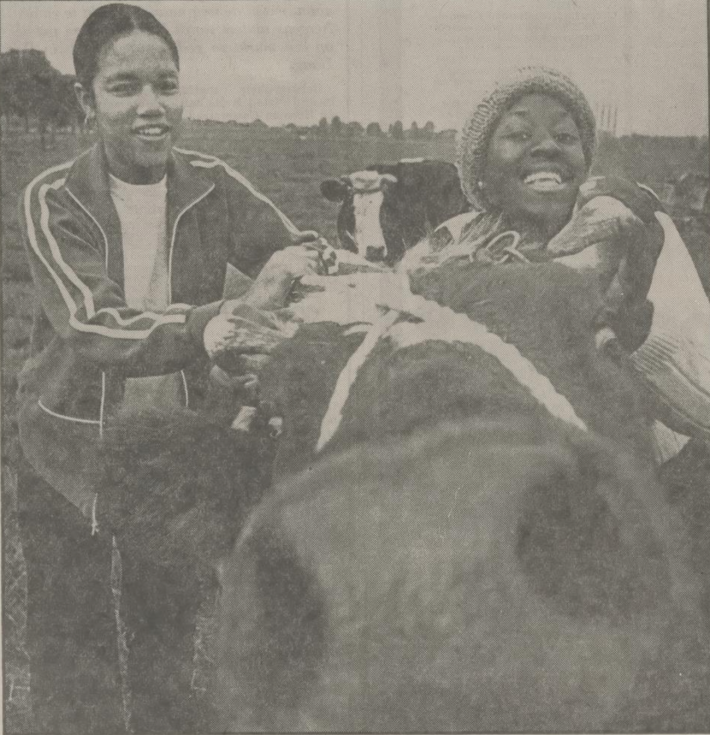
“I was afraid,” Hicks said, remembering the airplane ride to the Netherlands. She’d never flown across an ocean, and described it as “too close to heaven.” On the other side, she found something she’d been craving: acceptance. “They treated me like a human being,” she told me.
Oud-Beijerland was home to about 15,000 residents and a basketball club sponsored by Vastgoed Strijen, a nearby real estate company. The team had finally built a new arena with the funding, leaving the parking garage where they competed until 1974, where cars had to be driven out before games. By 1976, the club was at a turning point, becoming the first team in Holland to infuse its women’s roster with two Americans: Cardte Hicks and Susan Williams, Mallory’s fiancée at the time.
Along with the arrival of Hicks, Basketball Oud-Beijerland had another not-so-secret weapon: Carla Benschop-de Liefde, a nimble point guard and all-time Dutch player, once crowned the European female basketball player of the year. Hicks maintained that Benschop was one of the best women’s basketball players she ever competed with or against. She died in 2006 at age of 56, but I spoke to her husband Wim Benschop, who played on the men’s team in the late 1970s and still lives in the small village by the Spui river. Remembering his wife’s friendship with the American, he said, “They completed each other.”
Indeed, the two women became fast friends. Together they led their team’s dizzying, free-flowing offense. “Girl, they used to tell me I had the green light,” Hicks said. “You know, a lot of time I hit the girls in the head because they weren’t looking … that’s where I got the name Magic.” Hicks and Benschop led the club to their only Dutch championship in 1979. According to Wim, “I know some guys here in the village, and they still talk about [Hicks].”
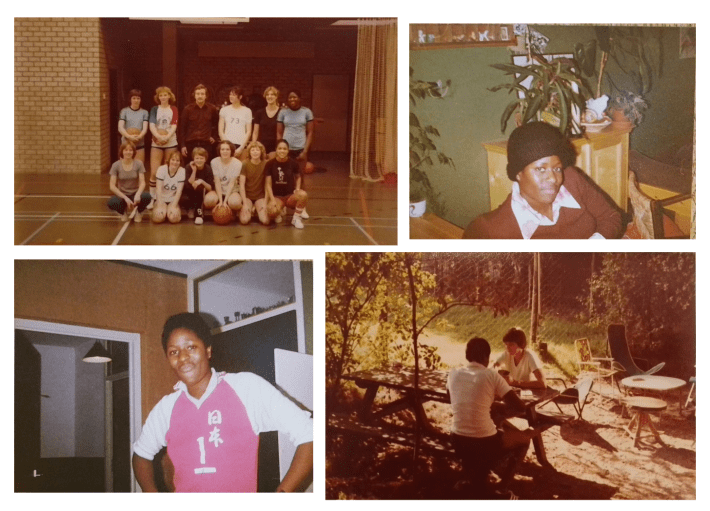
In the Benschops’ collection of family photos, Hicks looks at ease: playing cards with Carla in the leafy backyard, relaxing during meals, sharing records, and petting the family dog, Oslo. Benschop told me that he and his wife were quite sad when Hicks left. They had a vision for the two women, how they could improve their respective games together. “I think it was a pity for [Hicks’s] development,” Benschop said.
Hicks’s time in the Netherlands also carried its own mystery: whether she ever dunked in a professional game. There’s a photograph from that era, a grainy black-and-white image where you can see Hicks leaping, hands above the rim, as she’s about to slam the ball through the hoop.
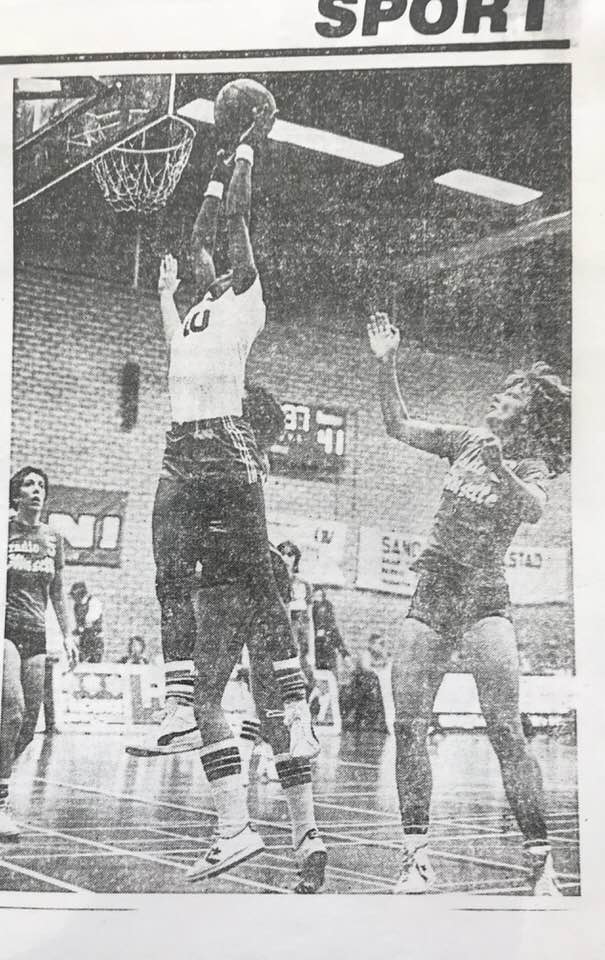
Many people attested to witnessing Hicks dunk. In one report from the Netherlands, Oud-Beijerland manager Bert Blaauw was quoted as saying, “She can do everything, is fast, has a strong shot, and is the first woman I have ever seen who can dunk the ball.” San Francisco Pioneers owner Marshall Geller told the Berkeley Gazette: “Cardie Hicks of our team is 5-10 and slam dunks.” In the News-Pilot feature, Hicks reportedly dunked a volleyball during halftime exhibitions in the Netherlands. The San Francisco Chronicle reported that Hicks dunked overseas, as did the Examiner. Former teammates Ortega and Fisher remembered seeing Hicks easily dunk a volleyball, while Roberta Williams recalled her dunking a basketball during warmups. And Hicks certainly remembered dunking in a game in the Netherlands.
And yet, the deeper I got into the life of Cardte Hicks, the more it became clear that her ability to dunk was not the most remarkable thing about her. Wim Benschop agreed. “To me, it seems like [dunking] should be the story of Cardte, but it isn’t,” he said. “Everybody loved her, also the opponents. That’s more the story about Cardte, I think to me—everybody loved to see her play. All the other things are secondary.”
With or without the dunk itself, it was her fluid play, her leaping ability, her overwhelming jubilation for the game of basketball that stood out.
Hicks remembered her time in the Netherlands as both full of love and isolation. While she was treated like a local celebrity, she also never felt so lonely in her life, she told me. But that changed when she started teaching basketball lessons to the local kids. “It was like it wasn’t all about me,” Hicks said. “It was about the kids. And they helped me.” This was just a year after the 1976 Olympic trials. “They helped me go through something that I really needed, that was a wound that hadn’t been healed, and they surely helped me heal it.”
After the Pioneers disbanded in 1981, Hicks wouldn’t compete again in the United States at the pro level. She spent the next 13 years in Europe, retiring in 1994 to take care of her ailing mother back home in California. By the time the WNBA began play in 1997, Hicks had moved on from basketball, working as a security guard in Sacramento. But she still wanted a shot to make the league. She quit her job to train for months. At an open tryout for the Sacramento Monarchs, she joined hundreds of other WNBA hopefuls, only to seriously injure her knee minutes into playing, ultimately resulting in knee replacement surgery. It was her final basketball heartbreak.
In the process of reporting this piece, I reached out to Sue Wicks, a forward for the New York Liberty during its early years and the first openly gay player in the WNBA. I wanted to know if she’d heard of Cardte Hicks, to get a sense of how far her name had traveled. “I knew about her through reputation,” she wrote in a message. “Her vertical leap was absolutely legendary. … She’s a perfect example of a player who gets lost to history but who might have had a real cult following had she played in this era.”
Unprompted, it was as though Wicks understood what I was really asking—not just about the legend of Cardte Hicks, but about what it meant to share her story. “There are so many missing pieces in women’s basketball history,” Wicks wrote. “One interesting layer is that players themselves have always been the curators and carriers of that history. We told stories down the line and across generations because we were often the only ones interested enough to keep them alive. … We’re used to being the keepers of these stories.”
Today, the WNBA is at a critical inflection point—not only because of a labor battle amid soaring profits, but also the history of its sport. The story that the league often fails to tell is the one that players from decades past must shoulder: that women’s basketball long predates the success of this one league. The sport is actually shaped by its so-called “failures,” by the generations of women who insisted on hooping even without mainstream support or investment. It’s the “keepers of these stories,” women like Cardte Hicks, Michelle McKenzie, Anita Ortega, Roberta Williams, and thousands more, whose accomplishments and struggles developed the spirit of women’s basketball as alternative, even radical.
Watching the success of the WNBA has changed Hicks, too. It proved that her own instincts about how women could play basketball were not wrong, just early. I think often of a quote she gave to the Sacramento Bee, before her Monarchs tryout in 1997: “That showboating, showing off what you can do with your body. Not just on the ground but in the air. I just want another chance to do that.” Hicks never got an opportunity to tell her story to the audiences of the WNBA, but now she watches players like Jackie Young and Caitlin Clark with pride. “To see what these girls are doing today, it just makes you think, Dang,” she said. “Only if. That’s what we all say now. Only if.”
These days, Hicks lives in Las Vegas with her wife Vida Ridley-Hicks, their two small dogs, and her older sister Mary, who recently moved in. Despite the ways in which basketball let her down, she still loves and preaches the game. Nearly three decades after starting her program The Legends: Kids First in 1997, Hicks still runs camps and clinics with a passion she first developed through teaching hoops in the Netherlands. And she carries an ardent positivity, a lasting gratitude.
“Sometimes, if you let it out, you can really release some of that pain that I’ve carried for most of my life,” Hicks told me recently. “I realized I wasn’t alone, you know, I’m not in this world alone doing and being who I was. Somebody out there is living my dream right now.”
Dan McQuade contributed additional reporting.